
PROGRAMS
in-tangible texts ed. 1
About in-tangible texts
in-tangible texts is an ongoing digital publication in Thai and English featuring commissioned texts by emerging writers from across Southeast Asia, critically engaging contemporary art of this region and their sites of production and display.
Read about in-tangible texts’ focus, mission, and mentorship here.
Read texts at: medium.com/@in-tangible_texts
Edition 1 Texts
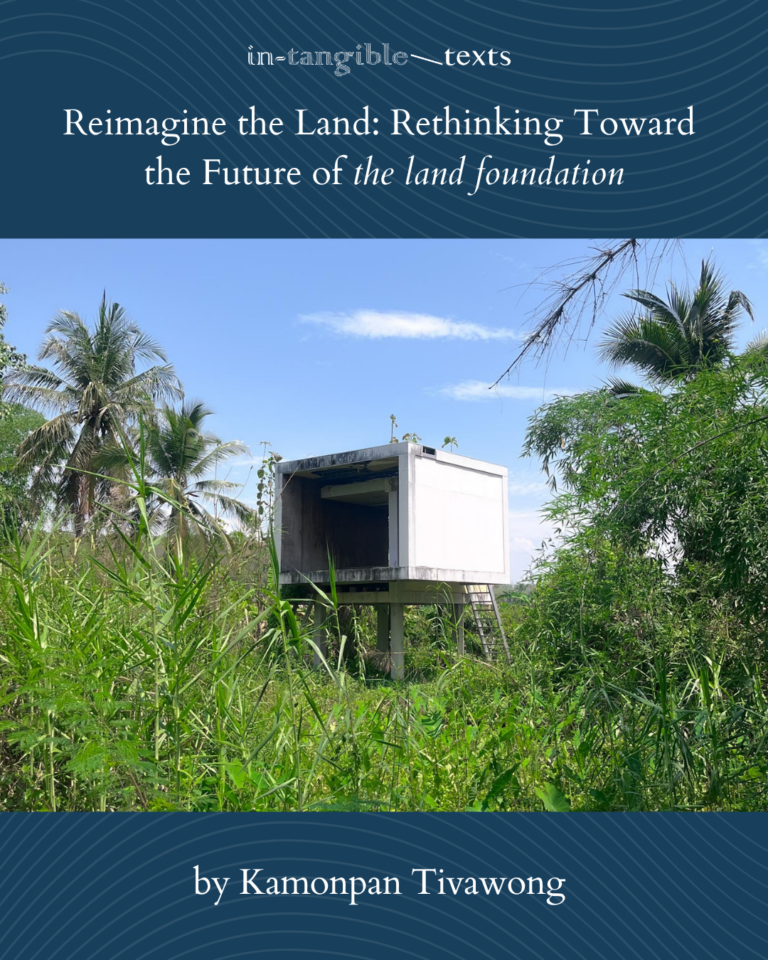
Reimagine the Land: Rethinking Toward the Future of the land foundation
By Kamonpan Tivawong
Kamonpan unpacks the history of the land foundation, exploring the ethos that shaped its beginnings and mapping possibilities for the land‘s future as a space to cultivate genuine social and ecological relations.
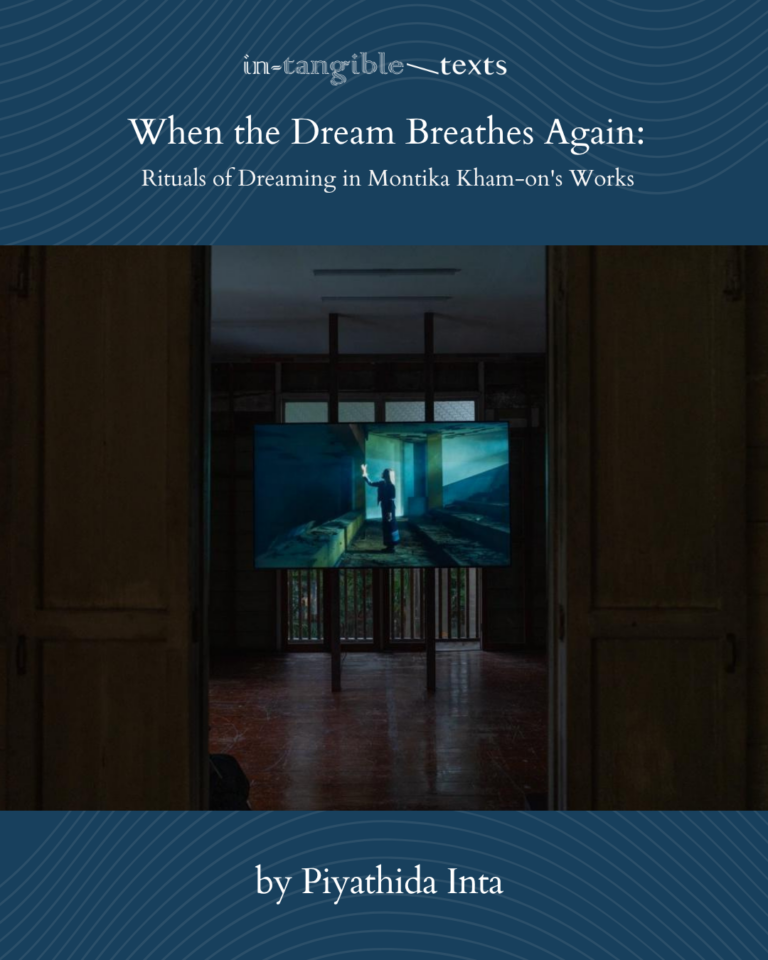
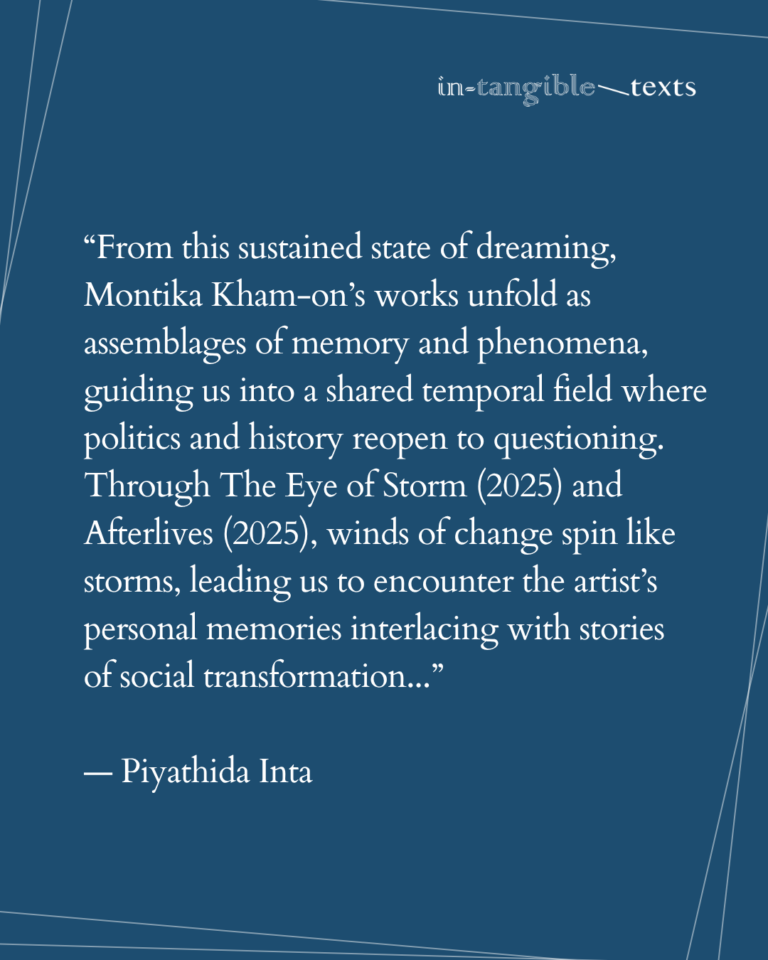
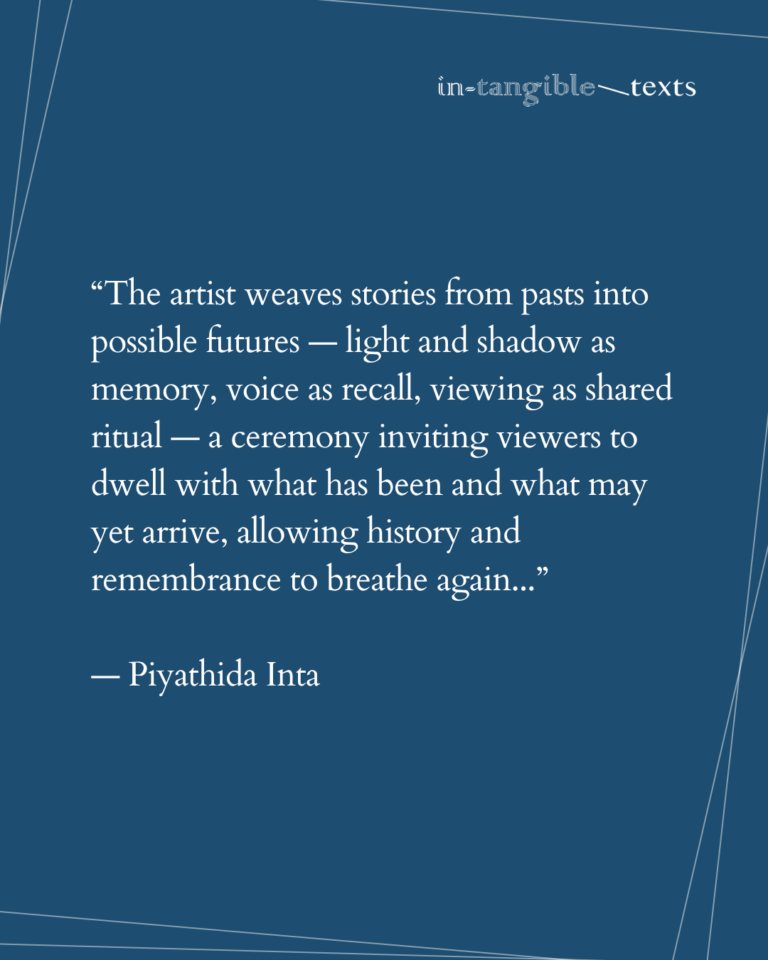
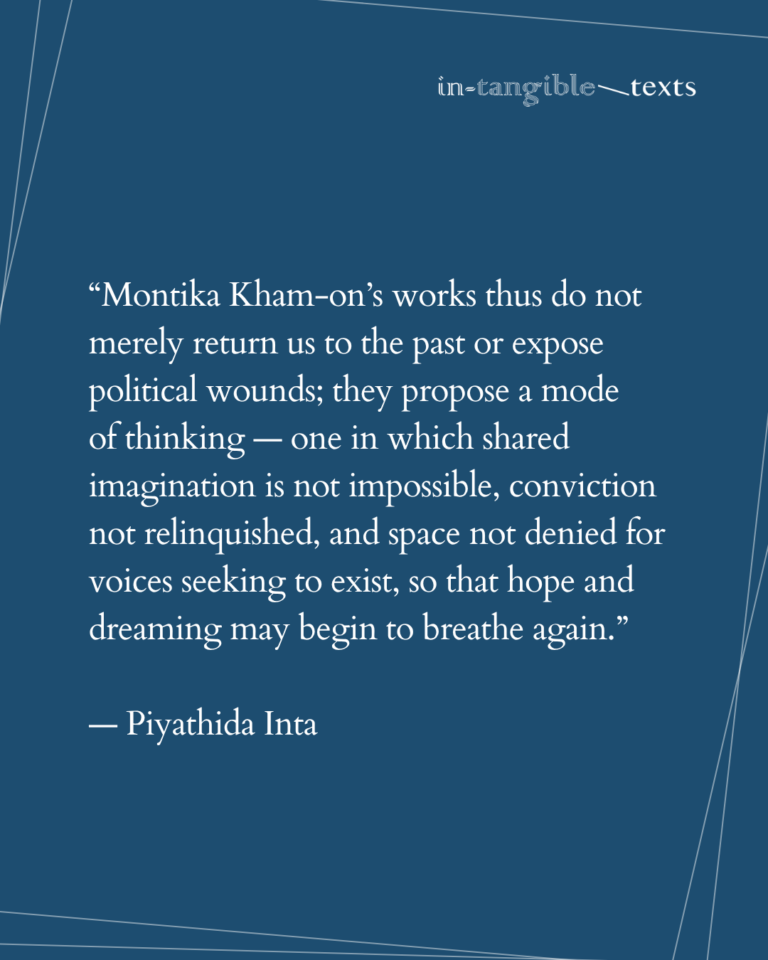
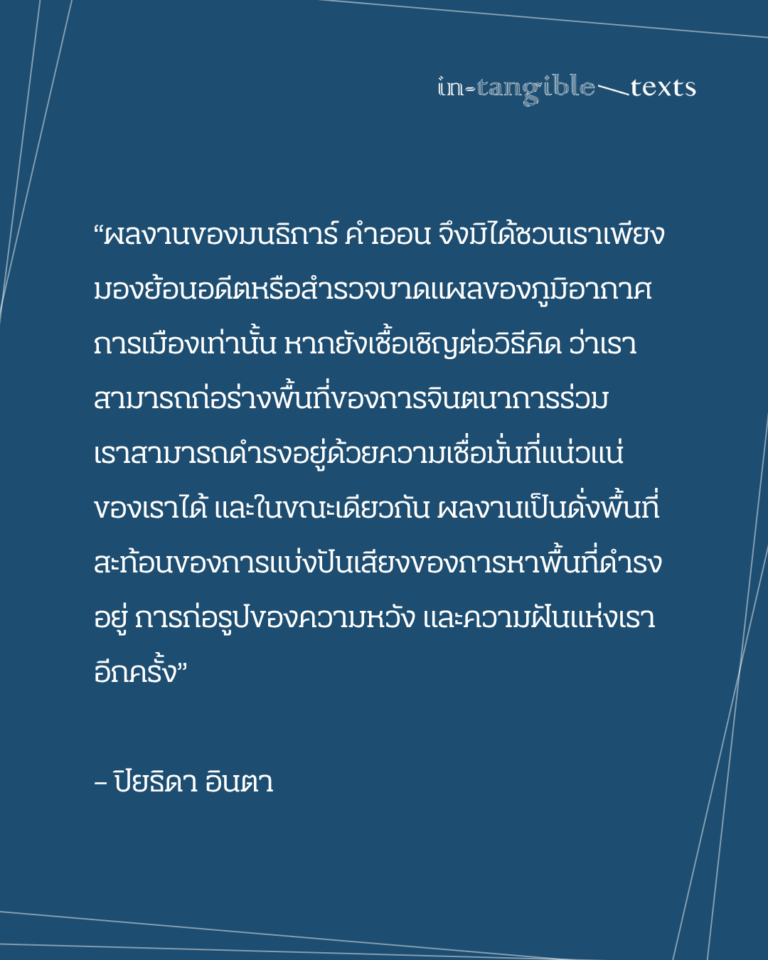
When the Dream Breathes Again: Rituals of Dreaming in Montika Kham-on’s Works
By Piyathida Inta
Piyathida contemplates dreaming as a collective ritual in moving image works by Montika Kham-on. She weaves poetic exploration with historical and political context to reflect on shared dreams of possible futures.
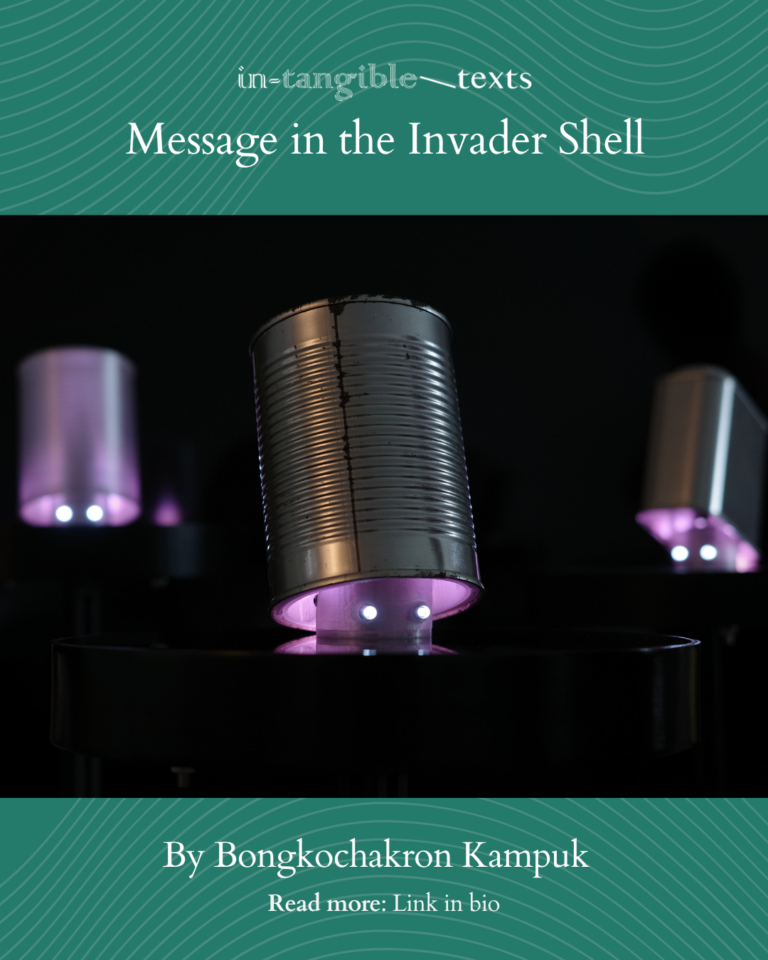
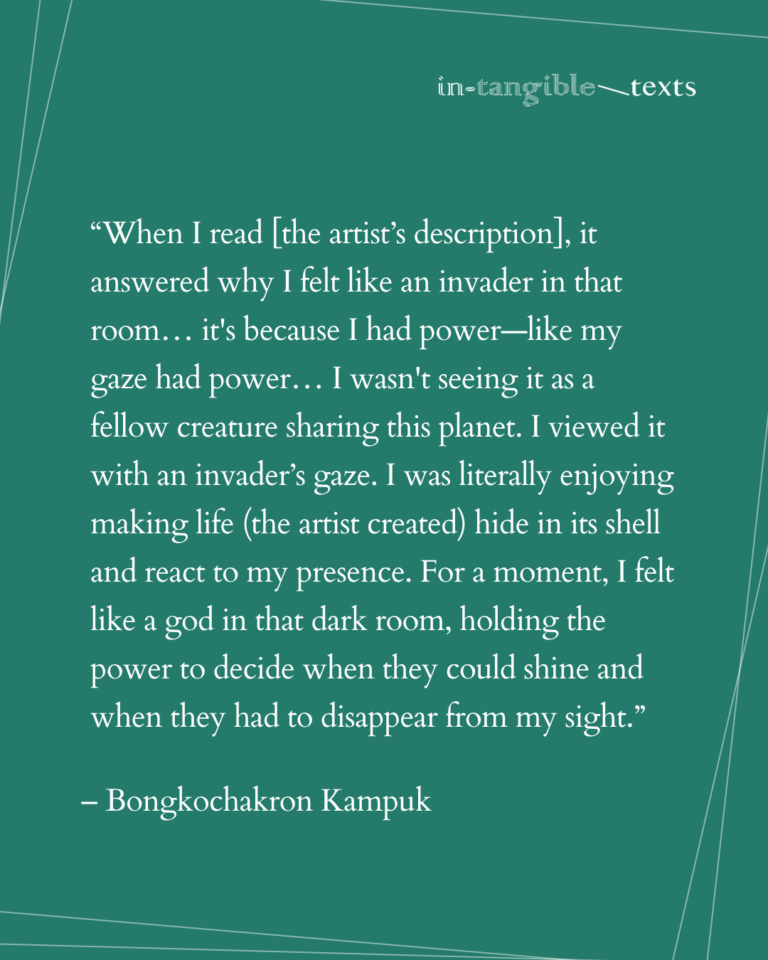
Message in the Invader Shell
By Bongkochakron Kampuk
Bongkochakron draws on works by Nakarin Rodput to explore the power of the “invader’s gaze”. She unpacks the impact of waste colonialism and the drive to create imperfect archives of ecologies damaged and destroyed by human consumption and development.
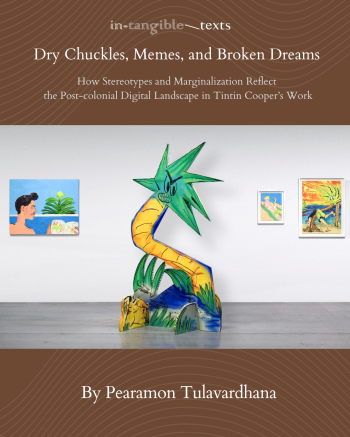
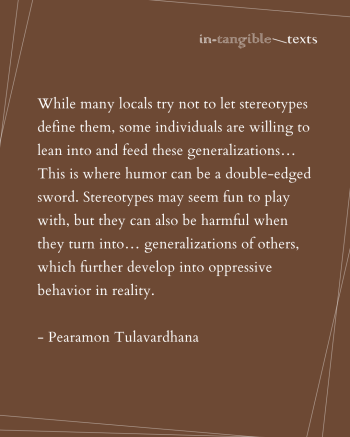
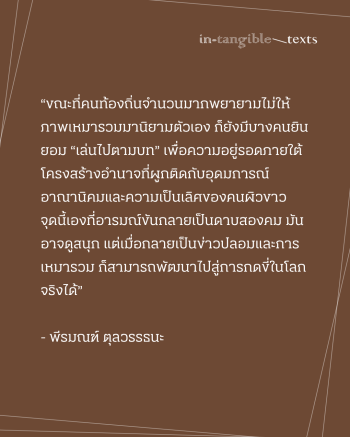
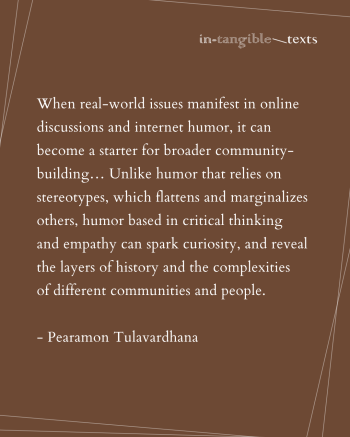
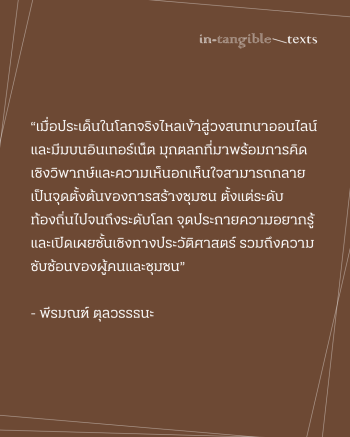
Dry Chuckles, Memes, and Broken Dreams: How Stereotypes and Marginalization Reflect the Post-colonial Digital Landscape in Tintin Cooper’s Work
By Pearamon Tulavardhana
Pearamon’s text contextualizes artist Tintin Cooper’s “Banana Ghost” in the digital landscape of memetic humor, thinking about how stereotypes in online memes reinforce the “othering” of already marginalized communities.
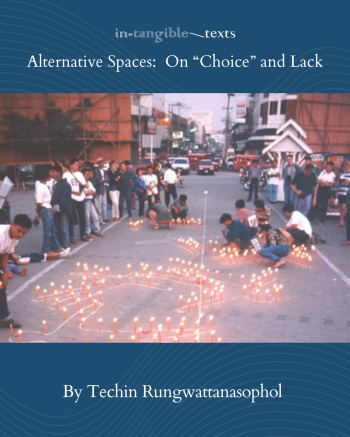
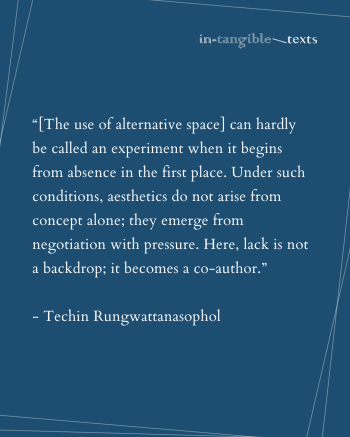
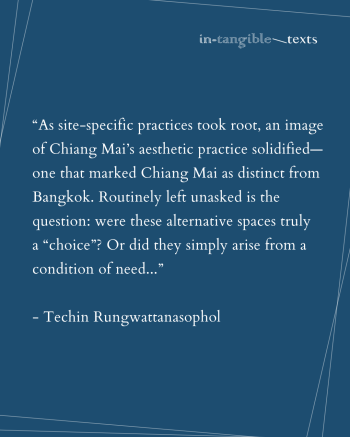
Alternative Spaces: On “Choice” and Lack
By Techin Rungwattanasophol
Techin’s text examines Chiang Mai’s reputation as a city whose artists make use of “alternative spaces”, paying critical attention to how this reputation sometimes works to hide a relative lack of cultural infrastructure outside of Thailand’s capital city
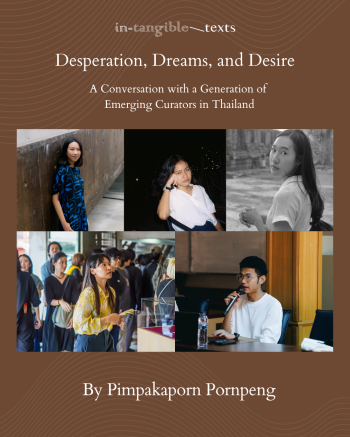
Desperation, Dreams, and Desire: A Conversation with a Generation of Emerging Curators in Thailand
By Pimpakaporn Pornpeng
Fahmui’s text unpacks the challenges facing her generation of curators in Thailand. Through conversation with peers covering their professional aspirations, their desire for spaces of discussion and exchange, and hopes for their individual and collective futures.
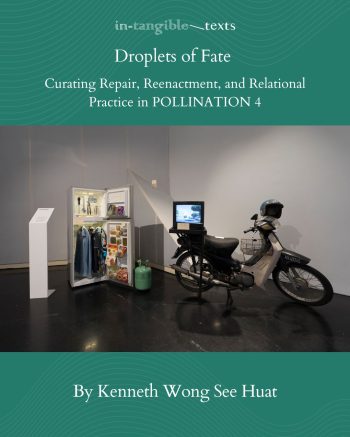
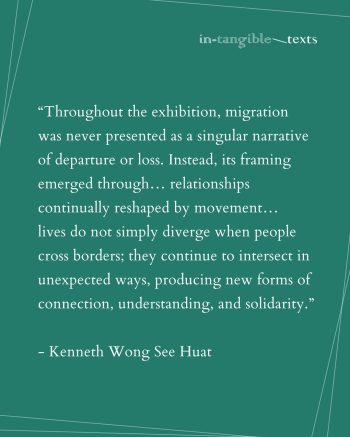
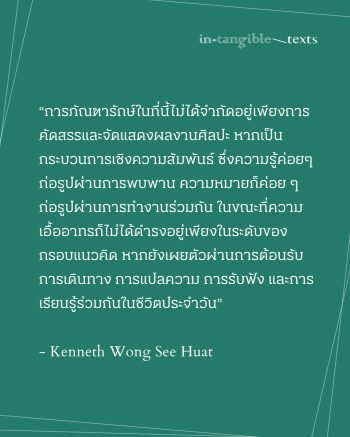
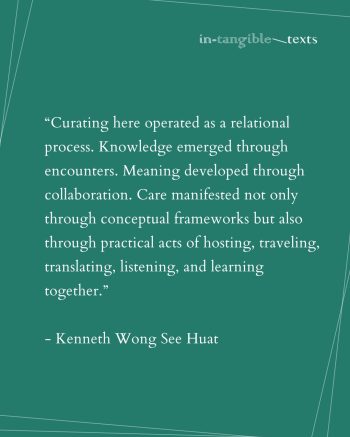
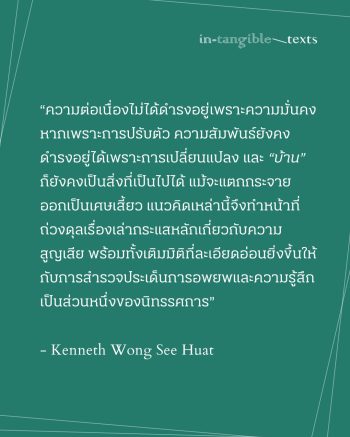
Droplets of Fate: Curating Repair, Reenactment, and Relational Practice in POLLINATION 4
By Kenneth Wong See Huat
Kenneth examines the curatorial process behind “POLLINATION ed. 4: the palms of y/our hands” as a collaborative endeavor of accompaniment, translation, reenactment, and repair between its contributors: co-curators Diana Nway Htwe and Mark Teh, and participating artists Okui Lala, M, Steven Nyi Nyi, and Jae Jae.
Edition 1 Writers
Kamonpan Tivawong (b. 1995, Sukhothai) is a photographer and independent curator. She is interested in the interconnectedness between human and non-human agency, examining how these relationships shape cultural identities and social histories. Through critical exploration with social contexts and environmental change, her work questions their impact on land, communities, and local belief systems. Kamonpan holds a Bachelor’s degree in Photographic Arts from the Faculty of Fine Arts, Chiang Mai University. Her curatorial projects include Just like heaven (if it doesn’t feel like hell), in-tangible institute, Chiang Mai (2024); curatorial contributor for LIVING ANOTHER FUTURE, MAIIAM Contemporary Art Museum, Chiang Mai (2024); and A History of…, co-curated at The Goodcery, Chiang Mai (2023). She lives and works in Chiang Mai, Thailand.
Piyathida Inta was born in 1998 in Chiang Mai, Thailand. Working across artistic practice, curatorial work, and writing, her practice spans conceptual art, artistic research, and creative writing. She investigates indigenous identity and womanhood, exploring the sense of home as place, memory, and the interweaving of personal and collective relationships. Her work begins with personal and familial stories examining how experiences pass between generations before expanding outward to engage with wider cultural questions. Grounded in critical thinking and contextual analysis, her curatorial approach focuses on creating dialogues between artworks, artists, and spaces.
She is currently curator and manager at the Museum of Broken Relationships, Chiang Mai, and co-curator for Phimailongweek (2024–2025), a self-organized art collective called àt-sà-jan! creating site-specific exhibitions in Phimai, Nakhon Ratchasima. In 2023, she presented her solo exhibition Transition of Thoughts Through Existing Relations. She received a scholarship as teaching and research assistant during her MA at Chiang Mai University (2021–2022).
Bongkochakron Kampuk is an art writer who utilizes writing as a means to make contemporary art more accessible. By viewing art through the lenses of history, mythology, and popular culture, she weaves profound concepts into the fabric of everyday life, inviting new interpretations unbound by conventional explanations.
Extending her practice to art archiving, she contributes to databases for the Thai contemporary art scene by collecting, documenting, and organizing information on exhibitions as well as the career paths of individual artists. Currently, as an art and culture content creator at GROUNDCONTROL, she has published over 300 pieces of content—including articles and video podcasts—that bridge the academic world with popular culture.
Pearamon Tulavardhana (b.1994) is a writer and independent curator based in Bangkok with a research interest in mythology, spirituality, and indigenous folklore as well as the relationship between technology and culture, mainly image-making and community-building. She graduated with a Master of Arts in Museum Studies and Curatorial Practice from Nanyang Technological University, Singapore. Formerly a gallery manager at Gallery VER, Bangkok, from 2018-2024, she currently works independently as a curator, editor, writer, and critic. Her alias, memeseumofcontemporaryartbkk, is an internet meme account that criticizes the art world, especially in Thailand. Her writings are published in Thai and English including in media such as Artreview Asia, The Momentum, Way Magazine, and Thairath Newspaper.
Techin Rungwattanasophol (b. 2003, Bangkok) is currently pursuing a Bachelor’s degree in Multidisciplinary Art at the Faculty of Fine Arts, Chiang Mai University. His practice moves fluidly between writing, artistic practice, and curation, viewing these not as separate disciplines but as an integrated process of inquiry. Through these interconnected methods, he explores and critiques the contemporary world.
Fahmui Pimpakorn Pornpeng (b. 1996) is a Thai curator, interested in focusing on how contemporary art engages with both human and non-human societies through a planetary and multisensory lens. Furthermore, she is fostering sustainable platforms for knowledge exchange within ecosystems through workshops and experimental programs.
She co-curated the exhibition The Supersensible (2023) at Taipei Digital Art Centre, the Ancestors (2024) at MAIIAM Contemporary Art Museum, and curated Apart a part exhibition (2025) at FAG Gallery, Khonkaen University and ALIEN Artspace. She earned an M.A. in Critical and Curatorial Studies of Contemporary Art from the National Taipei University of Education (NTUE) Taiwan, B.A. in Art History from Silpakorn University in Thailand. Fahmui is now an assistant curator at Dib Bangkok.
Kenneth Wong See Huat is an independent curator, writer, researcher, and founder of People Ideas Culture. His work explores the intersections of contemporary art, cultural heritage, migration, community participation, and everyday forms of memory across Asia. Trained in urban planning, cultural landscape studies, and curatorial practice, he has worked across disciplines including heritage conservation, cultural tourism, social innovation, and community-based art projects. Kenneth has presented and published internationally on topics ranging from food heritage and cultural mapping to queer ecologies and relational curatorial practices. He currently serves in advisory and leadership roles with several heritage and cultural organizations, including ICOMOS and ICOM. Through exhibitions, essays, walking projects, and public programs, he is particularly interested in how stories, places, and communities can be connected through acts of listening, interpretation, and collective care.
Edition 1 Mentors
Thanavi Chotpradit is an art historian, independent curator, and member of the editorial collective of Southeast of Now: Directions in Contemporary and Modern Art in Asia, a peer-reviewed journal focusing on Southeast Asian modern and contemporary art. She currently serves as a lecturer at the MA in Critical and Curatorial Studies of Contemporary Art (CCSCA), National Taipei University of Education (NTUE), Taipei, Taiwan. She co-organized writing workshops such as “Writing Modern and Contemporary Art in Southeast Asia: Transnational Approaches and Local Ecologies” (2021) and “Art Writing and Publishing in Southeast Asia: Sustainable Ecosystems and Infrastructures” (2024) with British Academy funding. In 2024, she was a Connecting Art Histories (CAH) Scholar at the Getty Research Institute, Los Angeles, and Scholar in Residence in the Sydney Asian Art Series, co-presented by the Power Institute and the Art Gallery of New South Wales.
Phanu Boonpipattanapong is a writer, columnist and father of two daughters, who is interested in the intersection of art, design, film, popular culture, and ordinary life. He lives in Bangkok and has written for Magazines Matichon Weekly, GQ Thailand, and websites The MATTER and iameverything.co.’
Lee Weng-Choy is an art critic based in Kuala Lumpur. For over twenty years, Lee lived and worked in Singapore, during which time he was Artistic Co-Director of The Substation arts centre for nearly ten years. He has taught at institutions such as the Chinese University of Hong Kong and the School of the Art Institute of Chicago, and in recent years, has focused on facilitating writing workshops in cities including Brisbane, Hong Kong, Kuala Lumpur, London, Manila, and Saigon. His essays have appeared in journals such as Afterall and American Historical Review, and in anthologies such as Modern and Contemporary Southeast Asian Art, Theory in Contemporary Art since 1985 and the Routledge Handbook of Contemporary Art in Global Asia.
Blake Palmer is a writer and cultural critic based in Chiang Mai, Thailand, working primarily on Southeast Asian contemporary art. He is interested in the intersection of culture, power, and art as a vector of sociopolitical critique. His academic work focuses on ecology and indigenous foodways in the Southeast Asian context. His recent work includes contemporary art analysis for Art Monthly Australasia, Southeast of Now: Directions in Contemporary and Modern Art in Asia, Aura Asia Art Project, and Art & Market, as well as multispecies ethnographic work for e-flux Journal and Ecological Indicators.
Blake is the Program Director of in-tangible institute.